Medication Adherence Math
Everyone agrees that better medication adherence is good for patients. But how good is it economically? The Congressional Budget Office has the answer.
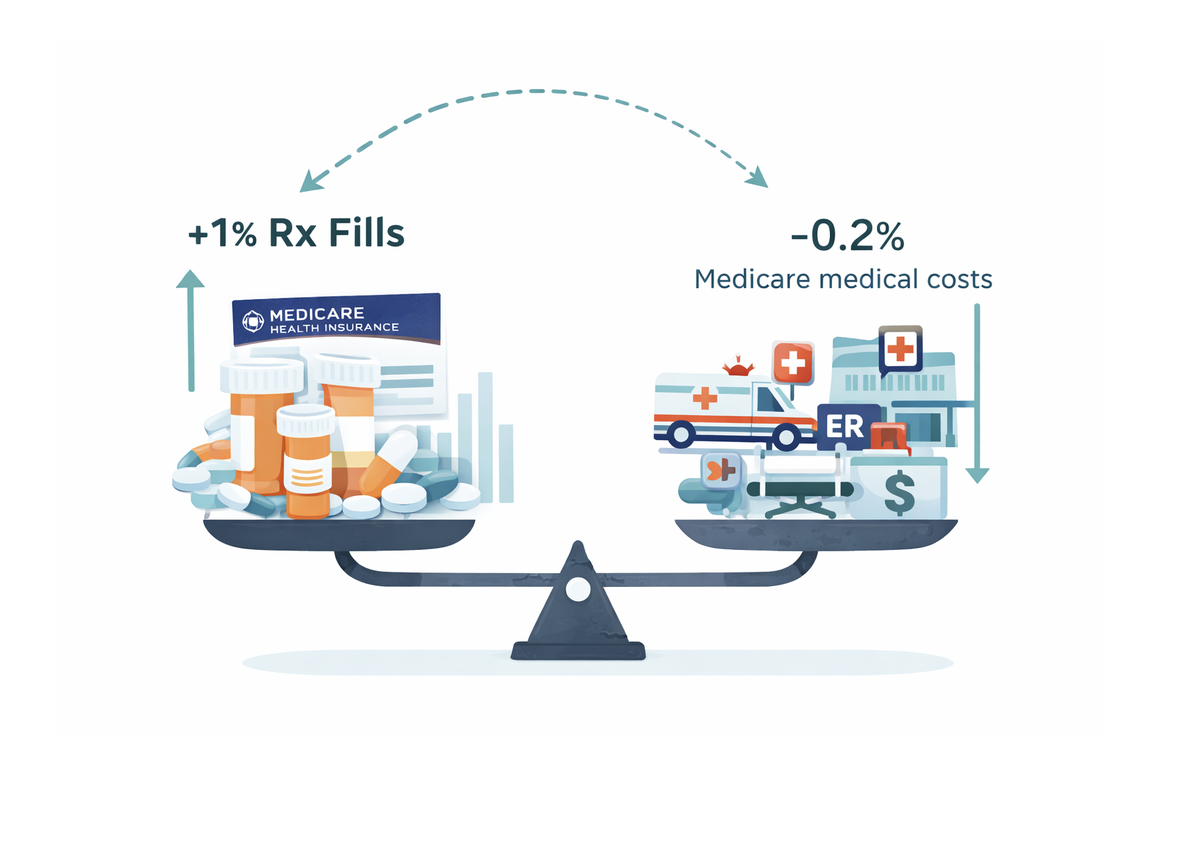
Everyone agrees that better medication adherence is good for patients. But how good is it economically?
In 2012, the Congressional Budget Office published a report titled "Offsetting Effects of Prescription Drug Use on Medicare's Spending for Medical Services." The core idea is straightforward: when patients take the right medications they stay healthier and often avoid expensive care later, such as emergency room visits, hospitalizations, and other medical services. These savings are known as "medical offsets."
CBO Finding
A 1% increase in prescriptions filled is associated with roughly a 0.2% decrease in spending on other medical services.
— Congressional Budget Office, 2012
What Does That Mean in Practice?
Medicare covers roughly 67 million people and spends about $839 billion annually. For simplicity, assume average adherence across the population is 50%. If a simple intervention — like reminder packaging — improves adherence by 10% on a relative basis (from 50% to 55%), CBO's ratio implies a 2% reduction in other medical spending (10% × 0.2).
Two percent of $839 billion is approximately $16.8 billion in annual savings. This is only for Medicare — imagine if implemented across other government and private programs. The numbers start to really add up.
While non-adherence has many causes, prescription packaging is one of the simplest, most scalable levers to pull — and potentially one of the most economically powerful. Unlike app-based interventions that require patient enrollment and ongoing engagement, packaging works passively, at the point of dosing, every single day.
Why Packaging Is the Most Scalable Lever
The math above assumes a 10% relative adherence improvement — a conservative estimate for packaging-based interventions. Research on reminder packaging consistently shows adherence improvements in the range of 10–20% relative to standard bottles, without requiring patient behavior change beyond the existing dispensing workflow.
At scale, this is not a marginal improvement. It is a structural shift in the baseline — one that compounds across millions of patients, thousands of pharmacies, and billions of prescription fills every year.
"Prescription packaging is one of the simplest, most scalable levers to pull — and potentially one of the most economically powerful."
Next Article